Who Wants to Live Forever? I do. But not in the way you think.
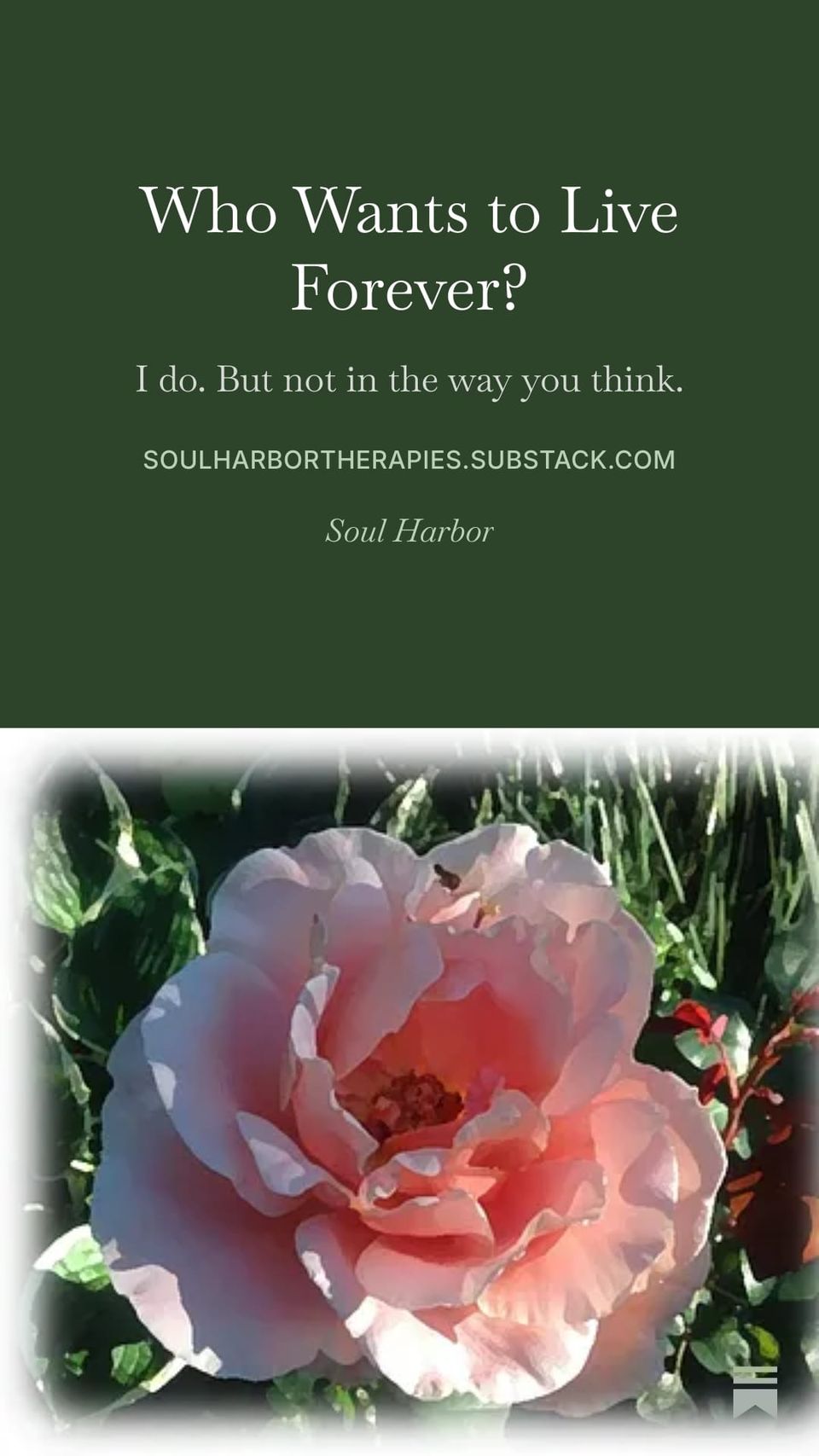
A year ago this week was my last day.
I keep returning to that date. The way my tongue returns to a gap where a tooth used to be. Testing it. Expecting pain. Finding something more tender than pain.
The honesty (Lunaria annua) in my garden has gone to seed. In spring, when I came home from hospital, it flowered white along the borders, mixed in with the bluebells (Hyacinthoides non-scripta), daffodils (Narcissus) and tulips (Tulipa). Now the petals are long gone. What remains are its delicate seed heads. Flat, papery moons. They are catching the low October light today and letting it through. They hold what the plant has made, waiting to be scattered by the wind.
I have been thinking about what remains.
My father taught me about roses when I was young. How to plant. How to prune. How to tend. In the evening light I would watch him deadheading, his thumbnail finding the place above the bud without needing to look. Cut clean, above the bud. Let the finished thing go. The plant will spend itself again.
Redundancy did not cut clean.
I was told it was the role and not me. I know that. I said it to myself many times. But it was still me. Thirty years of it was me. The plaster was ripped off in one movement, and I was not ready for it. In an earlier piece I called it the second rupture. The first had been my body. The second was the scaffolding of who I believed myself to be.
What followed were months of soul searching and asking a question that I could not leave alone. Who am I now?
It was not a new question. I had been asking it for most of my life, in different forms and media. Self doubt has its own empty architecture. Mine was laid down early, brick by careful brick. I learned that I was only as good as my last achievement. So I achieved. Another qualification. Another programme. Another committee. Another late night, the screen glowing long after the house had gone dark. Each success was a heavy sandbag against a seeping flood.
What looked like confidence on the outside was me running, trying to stay ahead of the self critical voice in my head. One that whispered I was not good enough. That one day I would be found out.
The job gave that voice something to do. It kept it busy. When the job was ripped away, the voice had my full attention again.
I am currently flirting with sixty. I do not have children. For a woman, that carries its own deafening stigma.
It is a strange kind of noise. It is made almost entirely of silence. The pause after the question. And do you have children? The small recalibration in a face. The conversation that turns, politely, towards someone else. Nobody says the words. They do not need to. The silence says them for you. Selfish. Barren. Unfinished. Sad.
For years, my work drowned that out too.
No title. No offspring. No one carrying my name or my face forward. Without my professional identity, what was left? Was I a failure? Or was there something else, waiting in the dark like a seed, for a season I could not yet perceive?
A few weeks ago I wrote The Long Shelf. I sat in a library and asked what deserves to be carried forward, and by whom. I wrote about the pharaohs, and the thousands of hands whose names are lost beneath the stone. About Horace and his monument more lasting than bronze. I ended by saying I did not want to live forever.
That was only half true.
I do want to live forever. Not in borrowed organs or purchased years. I want what I have given and shared to keep living after this lifetime has ended.
For most of my working life I believed I knew where that would happen. In the work I did. In the degree programmes I authored and led. In the curricula I designed, the policies, the quality frameworks, the governance. I believed I was building something that would last, that it would make a difference. I believed some part of me would carry forward.
I should have known better.
The day after my father died, I went back to work. I wore black. At the top of a staircase a colleague looked down at me, and smirked. A small gesture. Gone in a moment. That moment taught me what an institution can hold, and what it cannot. I learned to fold my grief and tuck it away. I carried on building.
Redundancy showed me the rest. I had given myself to a system that did not give a damn. An institution keeps a long memory for its processes. It keeps almost none for its people. The policies I wrote will be revised. The committees will meet without me. The building carries on. It already has.
I had been searching for my legacy on the wrong shelf.
Then a former student got in touch.
She did not write about a programme or a policy. She wrote to me. She reminded me of the voice I had used for thirty years. To educate. To communicate. To share. To make a difference. A voice I thought I had switched off along with my staff login.
I am so grateful to her. She pulled me up. Her message sent me back through my own life, looking for the people who had left their legacy in me.
The first was a teacher.
She will not amount to anything.
Spoken by an adult who should have known better. Overheard by a child who would never forget. It arrived like a shard of glass. It did not stay on the surface. It worked its way in, and became both wound and fuel. It still shapes how I read every mistake. Every lost list. Every word that would not stay still on the page. She will never know what her legacy was. But she left one.
The second was a tutor.
I was in my late twenties, on a training course about identifying neurodivergent students and making reasonable adjustments for them. We were learning the signs of dyslexia and dyspraxia. As the list went on, I heard myself say out loud that this was my reality as well. Words swirling, refusing to stay still. Long strings of numbers slipping away before I could hold them. The perpetual exhaustion. The panic at the front door every time I left the house. Have I forgotten something? What have I forgotten?
The tutor overheard, and suggested I get tested. I did.
The diagnosis made everything fall into place. For the first time in my life, I did not feel stupid.
I was on a course to learn how to notice others. Someone noticed me. One sentence had told a child she would not amount to anything. Another, spoken almost in passing, began to take the shard out.
Years later, at art college, there was another tutor. I will not call him careless. He lifted my fledgling holograms above his head, weeks of work, and smashed them one by one on his office floor. “Clean it up,” he said, and left me kneeling in the glittering ruin.
As I swept, I lifted a shard no larger than my fingernail. The whole image was still inside it. Luminous. Intact. Tear a photograph and its meaning changes for good. Break a hologram and every fragment still holds the whole.
He thought he was punishing me. He handed me the truest thing I know.
The third was a stoma nurse.
My bowel ruptured. I woke from emergency surgery with a colostomy I did not know I had. I had no idea what a colostomy was. How it worked. What it would mean for the rest of my life. I was too ill to change my first bags myself. And I was terrified of Percy, my stoma, and of everything people associate with having a bag.
Then she came to see me in critical care.
She had the most amazing smile. Positive. Full of energy. Full of life. In a ward bay that offered a famine of sky, she arrived like light through a window. She taught me how to change my bag myself. It took me almost three weeks. Three weeks of fear. Of looking away. Of not wanting this to be my body. But she had already shown me another way of seeing it. Slowly, I began to see it too.
Her legacy was framing life changing surgery differently. A way of holding life with a stoma that is not built on shame. I still carry it. If someone with a new stoma finds my words, they are meeting her legacy too.
When I finally came home, I sat in my garden. A blackbird sang. The tears came, the first since my operation. Nature was my witness. But I see now it was not the garden alone that brought me home. It was the people who had held me on the way.
And beneath all of them, my father.
He gave me On Death and Dying when I was fourteen. Years before I would need it. Not a warning. A map, passed across the wood grained table without ceremony. He believed women should be well educated. That conviction is the ground I stand on. Whenever I reach for that book, I am reading from a shelf he stocked.
In his last months, I wrote for him. Hypnotherapy scripts, read aloud at his bedside. One was about trees. I asked his breath to travel down into his roots, and rise again into his branches, to touch the sky. He had taught me roses. At the end, I taught him the forest, in the language he had planted in me.
I have written about all of this in The Inheritance of Three. What I did not see then, I see now. His legacy did not arrive as a monument. It arrived as a book in a young girl’s hands. As roses that still open every June. As a voice, returned to him at the one moment he most needed to hear it.
A careless teacher. A tutor who overheard. A tutor who smashed the glass. A nurse with the most amazing smile. A father with his roses. A student who wrote to me.
Not one of them would have called what they did a legacy. Some of it was careless. Some was cruel. Some was deliberate. Some was simply a person paying attention at the right moment. It does not really matter which. All of it shaped a life. Mine.
And somewhere along the way, without knowing it, I had become for my student something of what that tutor and that nurse had been for me.
That is what I could not see a year ago. I thought I had lost my legacy when I lost my job. I hadn’t lost my legacy. I had been looking for it in the wrong place.
It was never in the institution. It was in the attention. In the moments when one person turned towards another and said, in words or without them: I see you. You are not stupid. This is not the end. Can I sit with you?
Think of the shard on that office floor. Each of us carries the whole image of the people who made us. A fragment small enough to lose in a coat pocket. Still luminous. Still intact. And every person we have taught, or held, or noticed, carries a fragment of us.
That is how we live forever. Some through the flesh and blood of their children. Some through music, art, discoveries, ideas. All of us through our words and our actions, and the way they settle in other people and keep moving long after we have left the room. In the Gospel of John, eternal life is not described as length. It is described as knowing. As relationship. I understand that differently now.
He gave me the book. I gave him the tree. A silver birch (Betula pendula), for his seventieth birthday. I have since learned what birches are for. They are pioneer trees. The first to return to broken ground, after fire, after clearing. They spend themselves on the soil so that slower trees can follow. There is an old saying that a society grows great when old men plant trees in whose shade they know they will never sit.
I have received my inheritances. This is the beginning of the one I give.
The honesty will scatter soon. She will not choose where her seeds land. Next spring they will flower in places I never planted. Through the cracks in the path. At the ragged edge of the border. We do not choose where our legacy lands. Only what we scatter.
So let me ask you. Who left a legacy in you? A teacher, a nurse, a stranger, a parent? A sentence that wounded you, or one that set you free. And who are you tending today, leaving a legacy in them without knowing it?
Tread gently. Breathe deeply. It all matters.
©Soul Harbor, Andrea Robertson-Begg, October 2026
Member discussion